Tokyo With Kids And A Stroller: The Hands-Free Planning Guide
Tokyo Skytree refuses any bag with a side over 60 cm, teamLab Borderless draws its line at 50 cm, and Tokyo Disneyland bans suitcases from the parks entirely. A stroller changes the whole calculation, because a folded pushchair often measures bigger than the suitcase it travels with. Here is what the venues, the rail operators and the storage networks actually publish, and what a family should do about it.
Short answer
A regular bag at a Radical Storage point in Tokyo costs 850 yen per day plus a 355 yen per-bag checkout fee, so one bag for one day is 1,205 yen. Strollers are exempt from Shinkansen oversized-baggage rules. Skytree refuses any item with a side over 60 cm, and teamLab Borderless refuses anything over 50 cm.
Tokyo reads as a stroller-friendly big city on paper, with lifts at most stations, and one of the least forgiving in practice the moment a pushchair meets a ticket gate at 9 a.m. The pavements are wide, the lifts exist, and the vending machines are a miracle of toddler diplomacy. The friction is elsewhere: the attractions. Tokyo Skytree prohibits any item with a side over 60 cm, enforced by bag inspection at entry. teamLab Borderless prohibits anything over 50 cm. Tokyo Disneyland does not let carts such as suitcases and roller cases into the parks at all, and a stroller counts as gear you have to plan around too.
The stroller line matters for this site because a folded pushchair is an oversized item in exactly the way a suitcase is. A mid-size folded stroller runs 80 to 100 cm long, which is bigger than the 60 cm Skytree rule, bigger than a standard coin locker, and comfortably over the 160 cm three-side total that triggers mandatory oversized-baggage seat reservations on the Tokaido Shinkansen. Every rule on this page that applies to a suitcase applies, dimensionally, to the pushchair as well. This guide collects what the venues and operators publish, where a family can genuinely park a bag or a stroller, and what the real costs are. The Luggage Storage in Tokyo directory behind this page lists 249 Radical Storage points across the city, every one of them a partner location that this site neither owns nor operates.
Is Tokyo Actually Doable With A Toddler, A Stroller And A Suitcase?
Yes, but only if the suitcase never travels with the child. Tokyo rewards families who separate the sightseeing day from the luggage day, and punishes those who drag both through the same ticket gate. Lifts exist at every major station but sit at the far end of long concourses, attraction bag limits are strict and inspected, and the arithmetic favours storing the case at 850 yen per day rather than carrying it. Plan the drop-off before the day starts.
The single biggest structural fact is distance. Ueno to Asakusa is a short hop, Asakusa to Skytree is one stop on the Tobu line, but each of those hops involves gates, stairs-avoidance detours and crowds that move at adult speed with no eyes for a wheel at ankle height. A parent managing a stroller and a wheeled suitcase simultaneously is managing two vehicles through every pinch point in the city, and Tokyo has thousands of them. The families who report smooth days are almost always the ones who parked the big bag first and spent the day with one hand free for the pushchair and one for the IC card.
The IC card point deserves a word because it is the one piece of Japanese kit a visiting parent will touch a hundred times a day. Suica and PASMO are the rechargeable transit IC cards used on trains, subways, buses and at many shop tills, and they also pay at some coin locker banks, which matters later in this guide when a locker is the right answer. A child in a stroller does not need their own fare while riding; the parent taps through and the pushchair goes through the wide gate beside it. The practical advice from every angle is identical: charge one card per adult, keep it in a pocket rather than the changing bag, and treat the stroller basket as the day-pack, not the luggage rack.
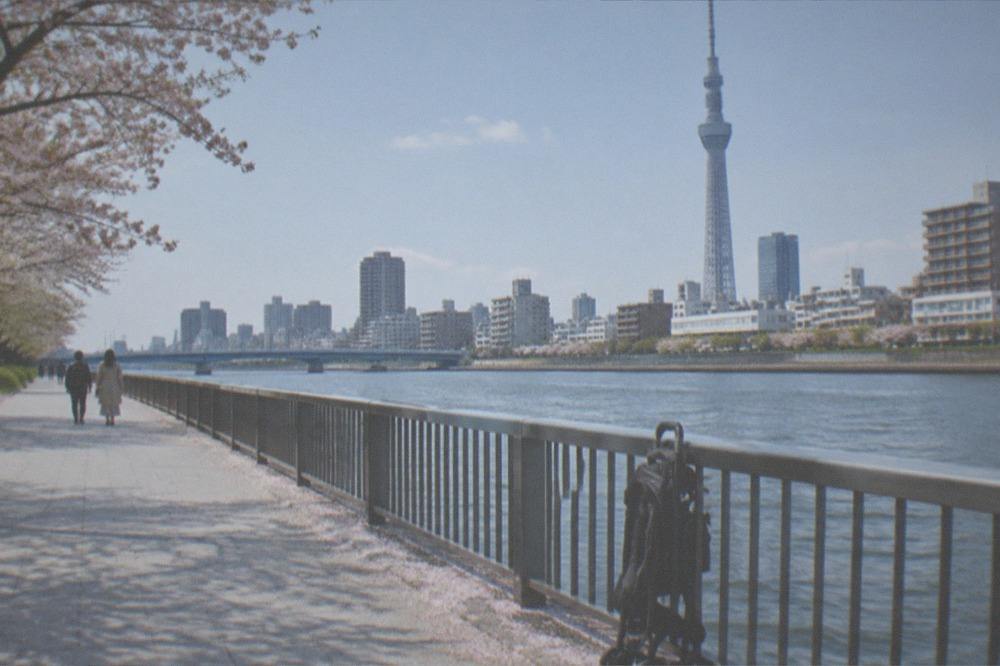
Distances between the family highlights are walkable, and walking with a stroller in Tokyo is genuinely pleasant outside the rush. Asakusa's approach streets are pedestrianised for much of the day. The Sumida river walk between Asakusa and the Skytree area is flat, wide and stroller-friendly. What is not walkable is a station interchange at peak time with a suitcase in tow, and that distinction, more than any attraction, is what a family should plan around.
Which Tokyo Attractions Turn Strollers And Big Bags Away?
The big family venues publish hard size limits and enforce them at entry. Skytree refuses any item with a side over 60 cm. teamLab Borderless refuses anything over 50 cm. teamLab Planets has no cloakroom and wire-locks oversize bags in an open stroller area. Tokyo Disneyland bans suitcases from the parks, and its biggest lockers sit outside the gates. A folded stroller or a checked suitcase fails at most of them.
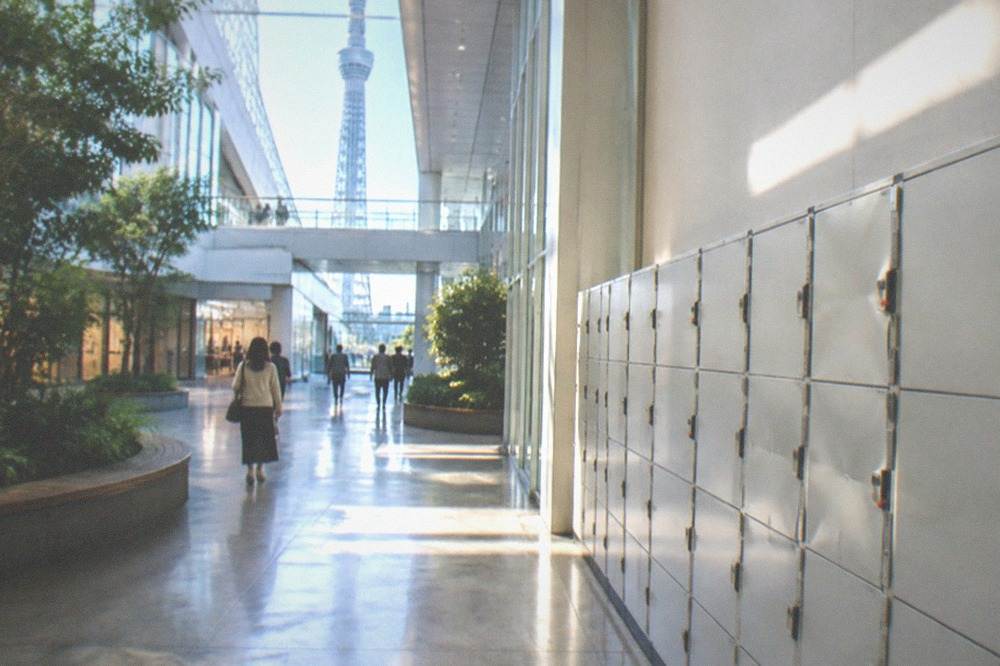
These are not soft guidelines. Skytree states its rule as items with any side over 60 cm and enforces it through bag inspection at entry, which means a cabin bag at 55 cm squeaks through and a folded mid-size stroller does not. A typical carry-on-size suitcase gets in; the checked bag that flew with you does not. Skytree's own guest page names the two paid answers, the coin lockers in Skytree Town and the Sagawa Express counter in Solamachi, and both are real options with real prices.
The two teamLab venues behave differently, and the difference matters for families. teamLab Borderless at Azabudai has no cloakroom, names a luggage room for strollers, offers free lockers, and prohibits items over 50 cm from entry. teamLab Planets at Toyosu goes further in one specific way: its free lockers measure 23 cm wide by 34 cm deep by 37 cm high, which holds a nappy bag and nothing else, and suitcases exceeding that size are, in the venue's own words, managed with a wire lock in the stroller storage area. That is materially weaker custody than a locker or a staffed counter, and a parent should know it before arriving with a case full of souvenirs. Both rules are on the venue's own visitor page.
Tokyo Disneyland and Tokyo DisneySea are the strictest of all. The resort states plainly that carts such as suitcases and roller cases are not allowed in the parks, and its Super-Extra-Large and Extra-Large lockers exist only outside the park entrances. Those big lockers cost 1,500 yen per day for the cash-and-e-money size, with interior examples of 116 by 46 by 64 cm published by the venue. Mori Art Museum in Roppongi, a common stop with older kids, has no cloakroom at all and 52nd-floor lockers that are free with a 100 yen coin returned, in two sizes, the larger of which measures W370 x D430 x H810 mm.
| Venue | Stroller and oversize policy | Published size limit | Paid storage on site |
|---|---|---|---|
| Tokyo Skytree | Bag inspection at entry, oversize refused | Any side over 60 cm prohibited | Skytree Town coin lockers; Sagawa counter at Solamachi |
| teamLab Borderless | No cloakroom; luggage room named for strollers | Items over 50 cm prohibited | Free lockers |
| teamLab Planets | No cloakroom; oversize bags wire-locked in open stroller area | Lockers 23 x 34 x 37 cm | Free lockers only |
| Tokyo Disneyland | Suitcases and roller cases banned park-wide | Not stated as a dimension | Lockers outside the gates, XL sizes outside only |
| Mori Art Museum | No cloakroom; offenders asked to leave | Two locker sizes, largest W370 x D430 x H810 mm | Free lockers, 100 yen coin returned |
The Disney detail is on the resort's official locker and storage page, and it is the one families most often discover at the gate. The pattern across every venue in the table is the same: nobody stores your stroller for you, several refuse your suitcase outright, and the drop-off has to happen before you arrive. That is the moment a reserved storage point earns its fee, and it is why families who book storage in Asakusa, near Skytree or around Ikebukuro arrive at the gate with nothing but the pushchair and the day-bag.
What Does Hands-Free Storage Cost For A Family?
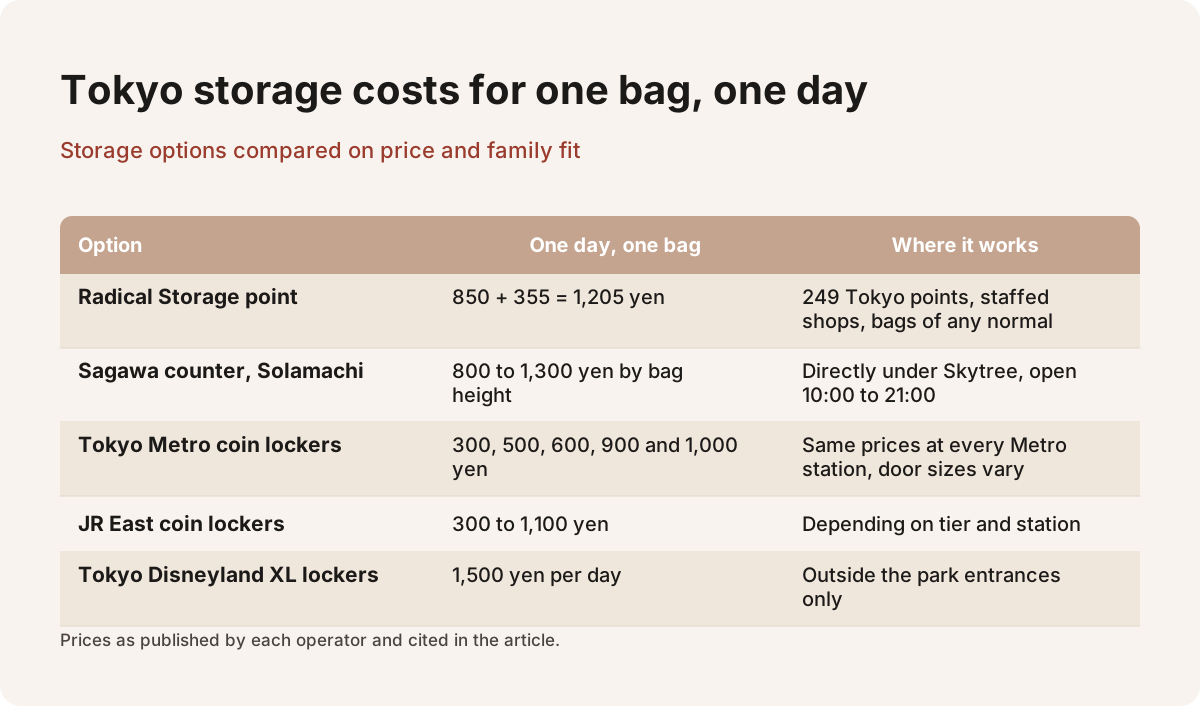
A regular bag at any Radical Storage point in Tokyo is 850 yen per bag per day, plus a 355 yen per-bag fee charged once at checkout, so one bag for one day comes to 1,205 yen in total. A few hours is billed as a full day. Coin lockers are cheaper for one day but cap out at small sizes, and the Skytree Sagawa counter charges 800 to 1,300 yen by bag height.
The arithmetic deserves spelling out because the headline rates understate a one-day booking by roughly a third. Radical Storage, the network behind every storage point listed on this site, charges 850 yen per bag per day for a regular bag at 244 of its 249 Tokyo points, and adds a 355 yen per-bag fee once at checkout. That fee does not scale with the number of days: one bag for one day is 850 plus 355, which is 1,205 yen, and the fee stays the same whether the bag sits for one day or several. Radical Storage advertises "from 490 yen per day", but that is a small-bag rate published by only 11 points, and it is never the price a family with a suitcase pays. There is no hourly tariff anywhere in the network, so dropping a bag for two hours costs the same as a full day.
The honest comparison is with the coin lockers, because they are the default thing a parent reaches for and they are genuinely cheaper for a single day. Tokyo Metro publishes one price ladder across its whole locker estate: 300, 500, 600, 900 and 1,000 yen, the same prices at every Metro station, with only the mix of door sizes varying by location. JR East's lockers run 300 to 1,100 yen depending on tier and station, with a 100 to 200 yen peak-season surcharge on the bigger sizes. The catch is dimensions, covered in full later in this guide, and the second catch is duration: Metro lockers run 4 days including the day you start, and JR East's Multi Ecube units 3 days, after which your bag is moved and the daily rate keeps running.
| Option | One day, one regular bag | Where it works for families |
|---|---|---|
| Radical Storage point | 850 + 355 = 1,205 yen | 249 Tokyo points, staffed shops, bags of any normal size |
| Sagawa counter, Solamachi | 800 yen up to 100 cm, 1,000 up to 160 cm, 1,300 over 161 cm | Directly under Skytree, open 10:00 to 21:00 |
| Tokyo Metro coin locker | 300 to 1,000 yen | Network-wide price ladder, small interiors |
| JR East locker | 300 to 1,100 yen | Varies by station, peak surcharge applies |
A note on what Radical Storage's guarantee actually is, because a parent handing a bag containing a child's things to a stranger should read it plainly. The network advertises a €10,000 guarantee; its own terms cap payouts at EUR 3,000 per claim, state in clause 9.2.2 that the guarantee is not insurance, and reserve the right to withdraw it. The cap stays in euros exactly as the terms state it. For a fuller breakdown of every yen figure in the city, the Tokyo luggage storage prices guide carries the complete tariff picture.
Where Are The Closest Family Storage Points To The Big Sights?
The Tokyo Skytree area has 3 Radical Storage points rated 4.77 across 132 reviews, the nearest 85 m from the tower. Asakusa has 13 points at 4.85 across 268 reviews, nearest 193 m. Ikebukuro has 10 points at 4.73 across 89 reviews, nearest 227 m. Skytree and Asakusa are all staffed counters, and Ikebukuro has 8 staffed points plus 2 lockers, which suits a family with a stroller: a person, a receipt and a door wide enough for a pushchair.
Skytree is the clearest case on the map. The tower itself refuses oversize bags at inspection, the Solamachi mall beneath it sells a Sagawa counter at 800 to 1,300 yen per day, and the Radical Storage points around the tower sit as close as 85 m from the entrance. A family doing the classic Asakusa-to-Skytree day can drop the suitcase at either end and walk the river between them with only the stroller aboard.
Asakusa is the deepest cluster in the directory, 13 storage points carrying a 4.85 rating across 268 reviews, every one of them a staffed counter. Senso-ji's approach streets are the stroller-friendliest walking in the city, which is exactly why the storage picture here is under pressure, a point the next section covers. Ikebukuro, for its part, is the family base that guidebooks undersell: 10 points at 4.73 across 89 reviews, an aquarium and sunshine-city shopping indoors, and a station where the lift routes are survivable. Ueno adds 8 staffed points at 4.87 across 285 reviews beside the park and the zoo, making it a practical zoo-day drop, with eight staffed points in the directory.
The Skytree numbers make the case on their own: three points, 4.77 across 132 reviews, nearest 85 m. For a family heading up the tower, that is a shorter walk than the queue for the observation deck.
Asakusa's 13 points are the largest cluster in the directory, alongside a 268-review pool, and the 193 m nearest-point distance means the drop happens on the way, not as a detour.
| Area | Points | Rating | Reviews | Nearest point | Staffed |
|---|---|---|---|---|---|
| Tokyo Skytree area | 3 | 4.77 | 132 | 85 m | 3 |
| Asakusa | 13 | 4.85 | 268 | 193 m | 13 |
| Ikebukuro | 10 | 4.73 | 89 | 227 m | 10 |
| Ueno | 8 | 4.87 | 285 | 171 m | 8 |
| Shinjuku | 8 | 4.75 | 384 | 187 m | 6 |
Can You Take A Stroller On The Shinkansen Without A Reservation?
Yes. Strollers are exempt from the Shinkansen oversized-baggage rule regardless of size, alongside sports equipment, musical instruments and wheelchairs. The rule that does apply is for suitcases: any bag with a three-side total over 160 cm needs a free reserved oversized seat on Tokaido, Sanyo, Kyushu and Nishi-Kyushu services, and boarding without one costs a 1,000 yen fee per journey.
This is the one place where the stroller genuinely wins and the suitcase does not. JR Central's own rule page lists strollers, wheelchairs, sports gear and instruments as exempt from the oversized-baggage scheme, no reservation and no fee, whatever the folded dimensions measure. A family with a stroller boards the Tokaido Shinkansen to Kyoto with no extra booking at all. The suitcase beside the pushchair is a different matter: over 160 cm in three-side total, which is any checked bag, requires a seat in the oversized-baggage space, and that seat costs the same as an ordinary reserved seat and must be booked before boarding. The absolute limit on board is 250 cm three-side total and 30 kg per item, with no item over 2 m long.
One trap deserves a flag because English coverage gets it wrong. Since 1 July 2025, the sixteen-car Tokaido sets have carried six free deck luggage corners in cars 3, 5, 7, 9, 13 and 15, first come, no reservation. Those free areas may not hold an oversize bag. A bag over 160 cm still needs the reserved seat even when free deck space exists, and writing off the reservation because free space exists is the fastest way to a 1,000 yen charge mid-journey. The JR East Shinkansen lines out of Tokyo, Tohoku, Joetsu, Hokuriku, Yamagata and Akita, have no oversized reservation and no fee at all, but no reserved slot either, which means a big case rides on luck.
The full seat-and-fee mechanics, including the exact penalty wording from the tariff, sit in the Shinkansen oversized baggage guide. For families the short version is enough: the stroller is free, the checked bag is a two-minute booking, and both facts come from the operators' own pages rather than secondhand summaries.
What Stroller Mistakes Do Families Make In Tokyo?
The most common mistakes are trusting a closed service, choosing a locker that cannot fit the pushchair, and carrying the suitcase into a venue that will refuse it. Asakusa's free tourist-centre storage ended on 31 March 2026. Toei's largest lockers are 34 cm deep, which defeats most folded strollers. And Skytree's 60 cm rule is enforced by inspection, not signage. Each mistake is avoidable with one piece of planning.
The Asakusa closure is the fact most live travel content still gets wrong. The Asakusa Culture Tourist Information Center's luggage storage service terminated on 31 March 2026, and Taito City's own notice explains why: travellers' suitcases were contributing to street congestion on the approach to Senso-ji. Plenty of English pages still list the service. A family arriving at the centre with a stroller and a case now finds a closed counter, which is precisely why the 13 staffed Radical Storage points around Asakusa, all of them real businesses with their own premises, have become the practical answer in that neighbourhood.
The locker-size mistake is dimensional and permanent. A Toei Subway large locker measures 856 mm wide but only 342 mm deep internally, and JR East's standard tiers are 34 cm deep too; the one genuinely wide tier is the LW at 86 by 56 by 65 cm, which English coverage almost never mentions. A folded stroller is a long, shallow, awkward shape, and depth is the constraint that defeats it. Lockers also carry a 30,000 yen contractual liability cap, matched by a terms ban on storing anything worth that much or more, which is a pairing worth understanding before a changing bag with a laptop inside goes into a machine. The full tier-by-tier numbers are in the Tokyo coin locker sizes guide.
The third mistake is the venue inspection. Skytree's 60 cm rule is applied by staff at the door, teamLab Borderless's 50 cm rule likewise, and both have named, priced alternatives within a short walk. The family that arrives at the gate with the checked bag has already lost the argument; the family that dropped it at a counter 85 m away walks straight through. None of these venues store strollers, so the pushchair itself stays with the parent everywhere in this guide, and that is worth accepting early rather than discovering at a turnstile.
How Does A Hands-Free Day With A Child Actually Run?
The workable pattern is one storage booking near the first stop, a walking loop between two neighbourhoods, and a pick-up timed before the last train. Drop the bag by 10:00, sightsee with the stroller and the IC card only, and collect between 17:00 and 19:00. Radical Storage points hold the bag all day for the single 850 yen day rate, and the 355 yen fee does not rise with the hours.
What the pattern rules out matters as much as what it includes: never plan a same-day bag move across the city, because every transfer doubles the gates, the lifts and the crowds, and the day rate already covers storage until the point's closing time. The classic loop makes the point concretely. A family staying near Ikebukuro drops the suitcase at one of that area's 10 staffed points, rides the Yamanote line to Ueno or Asakusa, walks the river path with the stroller to the Skytree side, and collects the bag on the way back through Ikebukuro in the early evening. Every leg involves one wide gate, one lift and no luggage, and the whole day's storage cost is the 1,205 yen arithmetic on a single bag. The alternative, dragging the case through Ueno's concourse and storing it twice, costs more in coins and far more in effort.
Ikebukuro's role in that plan is the base camp: 10 points at 4.73 across 89 reviews, a station that families can cross with a stroller, and indoor attractions for the afternoon slump.
For families extending the idea beyond the city, the same logic applies with even more force: a bag forwarded or stored in Tokyo beats a bag carried onto a regional train, and the day trips from Tokyo without your bag guide works through the options. The short version for parents is that hands-free is not a luxury on those trips, it is the difference between a day trip and an endurance event. If the return timing slips, the where to store luggage for a few hours guide covers the evening and short-stay cases, including the points that stay open late into the night.
One last timing note that is pure Tokyo: the last trains run between roughly 23:00 and midnight depending on the line, and a stroller on a final-service train is nobody's idea of a good ending. Collect the bag, collect the child, and be on the platform with margin. The storage point keeps the bag until its own closing time, which varies by location, so check the hours on the point's page when booking rather than assuming a late-evening pick-up everywhere.
Common Questions About Tokyo With Kids And A Stroller
Can I bring a stroller into Tokyo Skytree?
Skytree's published rule prohibits any item with a side over 60 cm, enforced by bag inspection at entry. A folded stroller longer than 60 cm on any side falls under that rule, and the venue's own guest page points to the Skytree Town coin lockers and the Sagawa counter at Solamachi as the paid alternatives. The Radical Storage points around the tower, the nearest 85 m away, take a regular bag at 850 yen per day plus the 355 yen per-bag fee.
Do I need to reserve Shinkansen seats for a stroller?
No. Strollers, along with wheelchairs, sports equipment and musical instruments, are exempt from the Shinkansen oversized-baggage rule regardless of size. A suitcase with a three-side total over 160 cm does need a free reserved oversized seat on Tokaido, Sanyo, Kyushu and Nishi-Kyushu services, and boarding without it incurs a 1,000 yen fee per journey.
How much is luggage storage per day in Tokyo?
At a Radical Storage point, a regular bag costs 850 yen per bag per day plus a 355 yen per-bag fee charged once at checkout, so one bag for one day totals 1,205 yen. There is no hourly tariff. Tokyo Metro coin lockers run 300 to 1,000 yen per day on one network-wide price ladder, and JR East lockers run 300 to 1,100 yen with a peak-season surcharge on larger sizes.
Are there coin lockers big enough for a stroller in Tokyo?
Most standard tiers are too shallow. Toei's large locker measures 856 mm wide but 342 mm deep internally, and JR East's standard tiers are 34 cm deep as well. The widest common tier is the JR East LW at 86 by 56 by 65 cm, the only standard box that takes a wide item lying flat. A folded stroller's length defeats the standard tiers even when the width fits, so a staffed storage point is usually the better answer for a pushchair-sized load.
Can I store a stroller or big bag at teamLab Planets?
Only partially. teamLab Planets has no cloakroom, its free lockers measure 23 by 34 by 37 cm, which holds a small day-bag, and suitcases exceeding that size are managed with a wire lock in the open stroller storage area, which is weaker custody than a locker or a counter. Anything that cannot be carried into the artwork spaces at all is prohibited there, so arrive with the big bag already stored elsewhere.
Is the Asakusa tourist centre luggage storage still open?
No. The Asakusa Culture Tourist Information Center's luggage storage service terminated on 31 March 2026, per Taito City's own notice, which names suitcase congestion on the streets around Senso-ji as one cause. Asakusa still carries 13 staffed Radical Storage points rated 4.85 across 268 reviews, with the nearest 193 m from the centre of the neighbourhood.