Shinkansen Oversized Baggage: Size Rules, Reservations And The ¥1,000 Penalty
A suitcase over 160 cm in combined dimensions changes the way a Shinkansen ticket is bought: it triggers a mandatory, free seat reservation on the Tokaido corridor, and a ¥1,000 charge if the traveller boards without one. Here are the exact thresholds, the lines the rule does and does not cover, and the alternatives when the case simply should not travel.
Short answer
A bag measuring more than 160 cm across its three sides combined counts as oversized on Tokaido, Sanyo, Kyushu and Nishi-Kyushu Shinkansen lines, and requires a free oversized baggage seat reservation. The absolute limit is 250 cm with no side over 2 m. Boarding without the reservation costs ¥1,000. JR East Shinkansen lines out of Tokyo require no reservation at all.
What Counts As Oversized Baggage On The Shinkansen?
A bag counts as oversized when the total of its three dimensions, length plus width plus depth, exceeds 160 cm. The absolute ceiling is a 250 cm three-side total, with no single side longer than 2 m, and the free allowance is two bags per passenger within those limits. Strollers, musical instruments, sports equipment and wheelchairs are exempt from the reservation rule entirely.
The number that matters is the sum, not the biggest side. A medium spinner from one brand can sit just under the line while a nominally identical case from another sits just over it, because the wheels and external pockets count as much as the shell does. A conductor measures what is in front of them, not the manufacturer's specification card, so measure with the wheels on and anything strapped to the outside included. JR Central's oversized baggage page states the threshold and the reservation requirement directly.
One detail most English summaries get wrong is the boundary itself. JR Central's Japanese introduction says "under 250 cm" in one paragraph and "250 cm or less" in its rule box, and the tariff text settles it: a bag of exactly 250 cm is allowed on board. Do not plan around a stricter limit than the rule actually imposes.
| Rule | Figure | What it means for the traveller |
|---|---|---|
| Oversized threshold | Over 160 cm three-side total | The bag needs an oversized baggage seat on Tokaido, Sanyo, Kyushu and Nishi-Kyushu lines |
| Absolute maximum | 250 cm three-side total | Nothing larger travels in the cabin, reservation or not |
| Single-side limit | 2 m | Long items like skis must stay under two metres |
| Free allowance | 2 bags, each within the limits | Ordinary bags up to the threshold need no special seat |
| Exempt items | Strollers, instruments, sports gear, wheelchairs | No reservation needed regardless of size |
The table is worth screenshotting before a shopping trip for a new suitcase, because the 160 cm line sits awkwardly in the middle of the medium case market: many medium cases land on either side of it depending on the brand and how they are measured. Anyone travelling with two such cases should also note the allowance is two items per passenger, not two oversized items: only bags over the threshold need the reserved space, and both free items must still fit the 250 cm and 2 m limits.
How Do You Reserve An Oversized Baggage Seat On The Shinkansen?
The reservation is made when the seat is bought: ask for a seat with an oversized baggage space, called a 特大荷物スペースつき座席, at any ticket window, machine or online booking channel. It costs the same as an ordinary reserved seat, so the reservation itself is free. The seat is a specific last-row seat with a dedicated luggage area behind it, and the number of such seats on each train is limited.
The mechanics are simple but the supply is not. Each train carries a fixed count of seats with the behind-seat luggage area, and on busy days, Golden Week, the New Year travel peak and summer weekends among them, they sell out while ordinary reserved seats remain available. A traveller who buys a normal reserved seat and plans to wedge a large case into the overhead rack will find the rack is shallow and a tall case will not fit, conductor or no conductor. Book the special seat at the moment of purchase rather than hoping to swap later.
Reserving at the window takes one sentence of Japanese or English: show the case, or its measurements written on paper, and ask for the oversized baggage seat. Online channels and ticket machines carry the same option marked with a luggage icon. If the special seats are sold out on a desired departure, the practical answers are an earlier or later train, splitting the journey, or leaving the case behind entirely, which the sections below deal with in order.
One planning note that belongs here rather than later: the reservation is per train, not per day. A traveller hopping off at Nagoya and continuing on a later service needs the special seat on both trains. The rule catches round trips too, since the reservation is tied to each journey segment and the penalty is charged once per journey, not once per ticket.
Which Shinkansen Lines Require The Oversized Baggage Reservation?
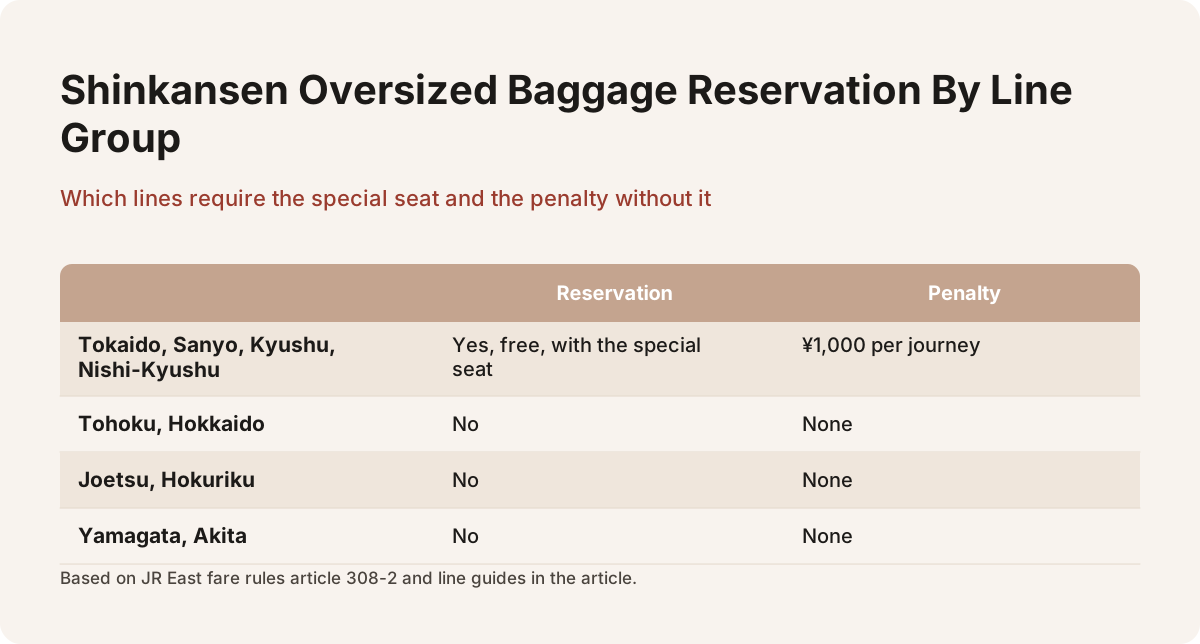
Only the Tokaido, Sanyo, Kyushu and Nishi-Kyushu Shinkansen lines require the reservation, which covers Tokyo to Hakata and the Kyushu branches. The JR East Shinkansen lines out of Tokyo, the Tohoku, Hokkaido, Joetsu, Hokuriku, Yamagata and Akita lines, require no oversized baggage reservation and levy no penalty, but they also guarantee no space, since luggage areas exist only on some trains and cannot be reserved.
The split trips up more visitors than the size rule itself. A traveller leaving Tokyo for Kyoto or Osaka is on the Tokaido line and inside the rule from the moment of purchase. A traveller leaving Tokyo for Sendai, Kanazawa or Niigata is on a JR East line where a big case simply boards, per JR East's own carry-on guide, which states the carry-on fee as free and the reservation requirement as no for suitcases within 250 cm, 30 kg and two pieces. The same trip with the same suitcase therefore has two different correct answers depending on the destination.
| Line group | Examples | Reservation required | Penalty without it |
|---|---|---|---|
| Tokaido, Sanyo, Kyushu, Nishi-Kyushu | Tokyo to Kyoto, Osaka, Hiroshima, Hakata | Yes, free, with the special seat | ¥1,000 per journey |
| Tohoku, Hokkaido | Tokyo to Sendai, Aomori | No | None |
| Joetsu, Hokuriku | Tokyo to Niigata, Kanazawa | No | None |
| Yamagata, Akita | Tokyo to Yamagata, Akita | No | None |
The JR East exception carries a caveat that must travel with it: no reservation also means no assured space. The luggage areas on those trains are first come, and on a crowded Tohoku departure a traveller with a large case may find the deck corners already full, with no rule to appeal to because none applies. Anyone taking a genuinely large case to Sendai or Kanazawa is gambling on boarding early.
Shinagawa is where the two worlds meet. It is a Tokaido Shinkansen stop, so the reservation rule applies on every Kyoto- and Osaka-bound departure from its platforms, and it sits on top of a cluster of staffed storage points that suit a traveller whose case should not make the trip at all. The Shinagawa area on the Radical Storage network holds three points, rated 4.45 across 12 reviews, with two staffed locations and one locker among them, and the rate is the network's standard 850 yen per bag per day plus a 355 yen one-time checkout fee, so one bag for one day comes to 1,205 yen.
The trade for a Shinagawa drop is simple to weigh: the station's own JR East Logistics counter inside the Central Gate charges 800 yen for a medium case on a weekday and 1,600 for a large one, while the Radical Storage points charge the same per-bag rate regardless of size. Whichever way a traveller leans, the storage decision belongs at booking time, not on the platform with a departure in eight minutes.
What Happens If You Board Without An Oversized Baggage Reservation?
A passenger who brings a bag over 160 cm onto a Tokaido-line Shinkansen without the special seat can be charged a ¥1,000 carry-on fee, tax included, once per journey. The charge is in the tariff text itself, not only on a marketing page, and the conductor may allow the journey to continue only after collecting it. The case then travels wherever the crew can place it, typically a deck corner if one is free.
The fee is unusual among Japanese rail rules in that it is written into the operating regulations rather than announced as policy. JR East's fare rules, article 308-2, name the exact lines it applies to, the Tokyo to Hakata corridor and the Kyushu branches, and set the amount at 1,000 yen per journey. The crew is not obliged to accept the bag at all; the wording says the railway "may" permit continued travel while collecting the fee, which leaves the final call with the conductor. A polite traveller with a genuinely full train may simply be out of options.
What the fee never buys is the good seat. Paying ¥1,000 does not convert the trip into the reserved arrangement; it is a penalty, not an upgrade, and the behind-seat luggage area belongs to whoever reserved it. In practice the crew moves an unreserved oversized case to the deck area at the end of the car, where it must sit unattended for the journey, locked or not. For anyone carrying anything worth more than the coin-locker world's ¥30,000 liability ceiling, an unattended deck corner is a weaker arrangement than a reserved space behind an occupied seat row.
The fee also compounds badly with connection risk. A missed departure because the oversized seats were sold out leads naturally to a non-reserved ordinary ticket on the next train, and that is precisely the situation the ¥1,000 rule exists for. Booking the special seat before arrival day, when the online channels still show availability, is the cheap insurance.
Where Does An Oversized Suitcase Go On Board The Train?
An oversized suitcase goes behind the last row of seats in its car, in the luggage space reserved with a special seat. Ordinary bags can instead use the reservation-free deck corners of Tokaido-line 16-car sets since July 2025, but a bag over 160 cm cannot, and it still requires the reserved seat; Supreme Class cabins in cars 7 and 10 accept baggage from 160 to 250 cm.
The 2025 change is the one most current writing gets backwards. The free deck corners were introduced on 1 July 2025 following an April 2025 press release from JR Central and JR West, and they solved the problem of ordinary suitcases fighting for overhead space on packed runs between Tokyo and Osaka. They did not touch the oversized rule. A traveller who reads "the Shinkansen now has free luggage space" and concludes the reservation is obsolete will board a Tokaido train with a large case and discover the deck corner is explicitly off limits to it.
The Supreme Class detail matters for a specific traveller. The premium cabin on the N700S and related sets accepts oversized baggage within the normal 160 to 250 cm band, which means a first-class passenger with a large case does not face the ordinary seat-map lottery, though the space is still not a private compartment. For everyone else, the geometry of the car decides everything: the overhead rack fits a case well under the 160 cm threshold, the last-row reserved space fits the oversized ones, and the deck corners fill on a first-come basis that rewards being at the platform before the boarding announcement.
Is It Better To Send An Oversized Suitcase By Takuhaibin Instead?
Sending the case ahead by takuhaibin, luggage forwarding, costs from ¥3,160 for a Tokyo-to-Kyoto 160 band suitcase and eliminates the seat reservation entirely, but the operators publish no delivery time for personal customers, so the bag arrives when it arrives and same-day hotel-to-hotel courier runs to ¥13,200 on the Shinkansen-borne LUGGAGE EXPRESS service. The arithmetic favours forwarding for long stays and storage for short ones.
The forwarding decision usually comes down to whether the traveller needs the case at the far end on arrival day. Yamato's TA-Q-BIN handles a 160 band suitcase from Tokyo to Kyoto or Osaka for ¥3,160, and a 200 band case for ¥5,410, with a hard cap of 200 cm and 30 kg, per Yamato's own size and fare tables. A 200 cm three-side total is below the Shinkansen's 250 cm ceiling, so most checkable cases qualify. Sagawa's large-size service goes further, accepting up to 260 cm and 50 kg, which covers cases the Shinkansen would take but a courier van might refuse elsewhere.
| Band (three-side total) | Tokyo to Tokyo | Tokyo to Kyoto or Osaka |
|---|---|---|
| 120 | ¥1,730 | ¥2,170 |
| 140 | ¥2,090 | ¥2,780 |
| 160 | ¥2,410 | ¥3,160 |
| 180 | ¥3,030 | ¥4,480 |
| 200 | ¥3,690 | ¥5,410 |
What no operator publishes for personal customers is a delivery time. Yamato's transit-time lookup is an interactive tool with no public service table behind it, and no carrier publishes a transit time for personal customers on any lane, so no honest page should promise one. The one dated, same-day option that is published is LUGGAGE EXPRESS, a JTB and JR Central service that carries bags by Shinkansen, hotel to hotel, for ¥13,200 per item Tokyo to Kyoto or Osaka with a 200 cm and 30 kg cap, card payment only.
Against those numbers, the storage side of the ledger is short: 850 yen per bag per day at a Radical Storage point, plus the 355 yen one-time checkout fee, is 1,205 yen for the first day and 850 for each day after. A four-day trip with the case left in Tokyo costs the 355 yen checkout fee once plus four days at 850 yen, against ¥3,160 to send a 160 band case one way, and the send-it option still needs someone at the far hotel to receive it. Forwarding also suits the homeward leg poorly, since a same-day hotel delivery back to an airport requires the airline-led services with their own cut-off times and hotel-only restrictions.
Where Can You Leave An Oversized Suitcase Near A Shinkansen Station?
Near Tokyo Station, you can leave an oversized suitcase at one of seven attended baggage rooms run by JR East Logistics, the most of any station in the city, costing ¥500 for a case up to 100 cm, ¥1,000 up to 200 cm, or ¥2,000 for anything larger, with storage available for up to 30 days. Ueno Station, Shinagawa Station, and Tokyo Station also sit close to Radical Storage points if you need another option.
The Tokyo Station rooms are the deep-storage option most visitors never hear about. The Yaesu South counter, outside the gates, runs 09:30 to 20:00, and the BAGGAGE STORAGE+ counter in the Gransta basement, inside the North gate, keeps the same hours, both holding bags for up to 30 days at the ¥500, ¥1,000 and ¥2,000 daily tiers. Two caveats from the operators' own pages: the Gransta cloak counter at the same station is same-day only, and the JR EAST Travel Service Center storage on the first floor is same-day only as well, so the 30-day arrangement belongs to the JR East Logistics counters specifically.
| Station and counter | Location | Hours | Price per bag per day | Max days |
|---|---|---|---|---|
| Tokyo, Yaesu South | Outside the gates | 09:30 to 20:00 | ¥500 / ¥1,000 / ¥2,000 by size | 30 |
| Tokyo, Gransta B1 | Inside the North gate | 09:30 to 20:00 | Same tiers | 30 |
| Tokyo, Shinkansen South Transfer Gate | Inside | 09:00 to 21:00 | Same tiers | 30 |
| Ueno, concourse 3F | Inside the Park Gate | 10:00 to 20:00 | ¥500 / ¥1,000 / ¥2,000 | 30 |
| Shinagawa, Event Space YK | Inside the Central Gate | 10:00 to 19:00, closed 1 January | ¥800 / ¥1,600 weekday, ¥1,000 / ¥2,000 weekend | Not published |
Shinagawa's counter carries a small trap worth flagging in a sentence: the weekday discount does not apply on several peak date ranges, including 27 April to 6 May, 10 to 19 August, and 28 December to 6 January, when weekend rates apply on weekdays. Anyone storing a case over those windows should expect the higher figure.
The Radical Storage side of the station cluster is the cheaper one for a single normal day, and the drop-off is a shop counter rather than a staffed rail logistics window, which means earlier opening and later closing at many points. The Tokyo Station area holds three points rated 4.89 across 213 reviews, the nearest 558 m from the station; Ueno holds eight points rated 4.87 across 285 reviews, the nearest 171 m; Shinagawa holds three rated 4.45 across 12 reviews. Every point in the network charges the same 850 yen per bag per day plus the 355 yen one-time checkout fee, so one bag for one day is 1,205 yen wherever in the city it is left. The Radical Storage Guarantee applies to all of them, and its own terms describe it as a voluntary scheme rather than insurance, with payouts capped at EUR 3,000 per claim.
Ueno deserves its own mention for the way it hides in plain sight: the JR East Logistics room sits on the third-floor concourse inside the Park Gate, so a traveller changing from the JR Yamanote line to a Ueno-bound Shinkansen connection walks past it without leaving the paid area. Its 30-day ceiling is the longest published hold among the station counters, which suits a long multi-stop itinerary better than a locker's three or four days.
For the full picture of what storage costs across the city, the Tokyo storage price guide breaks the 850 plus 355 arithmetic down by day count, and the oversized luggage storage guide covers where genuinely large cases fit when a standard locker will not. Anyone weighing the seat reservation against a case that never boards at all can also read how luggage works on the Shinkansen end to end. For a complete map of staffed drop-off points, Luggage Storage in Tokyo lists every Radical Storage point by station area.
Common Questions About Shinkansen Oversized Baggage
What counts as oversized baggage on the Shinkansen?
A bag whose three sides total more than 160 cm. The absolute limit is a 250 cm three-side total with no single side over 2 m, and a bag of exactly 250 cm is allowed. Two items per passenger travel free within those limits, and strollers, musical instruments, sports equipment and wheelchairs are exempt from the reservation requirement regardless of size.
How do you reserve an oversized baggage seat on the Shinkansen?
Ask for a seat with an oversized baggage space when buying the ticket, at a window, a machine or online. The seat costs the same as an ordinary reserved seat, so the reservation is free, and it places the bag in a dedicated area behind the last row of the car. The number of such seats per train is limited and they sell out on peak travel days.
Which Shinkansen lines require the oversized baggage reservation?
The Tokaido, Sanyo, Kyushu and Nishi-Kyushu lines, covering Tokyo to Hakata and the Kyushu branches. The JR East lines out of Tokyo, the Tohoku, Hokkaido, Joetsu, Hokuriku, Yamagata and Akita lines, require no reservation and charge no penalty, but their luggage areas exist only on some trains and cannot be reserved.
What happens if you board without an oversized baggage reservation?
The crew may charge a ¥1,000 carry-on fee, once per journey, and may allow the journey to continue after collecting it. The fee is in the tariff text, not a discretionary surcharge, and it does not buy the reserved luggage space; the case goes wherever the crew can place it, usually a free deck corner.
Do strollers and sports equipment need an oversized baggage reservation?
No. Strollers, musical instruments, sports equipment and wheelchairs are exempt from the oversized baggage rule regardless of their dimensions, so they board without the special seat on every Shinkansen line, though they still need to fit the ordinary carry-on limits of two items per passenger.